How to Store Your Kitesurf Gear Between Seasons (and Where to Do It)
Kite gear maintenance and how to store it
For anyone storing their kite gear for a long stretch
A kite, a bar, a board, a harness and a wetsuit easily add up to several thousand euros. And yet a lot of gear gets damaged without ever touching the water: in the boot of a car, in a damp storage room or in the sun on a terrace. If you are going to stop for a few weeks, or a few months, it pays to know how to store it properly and where.
The four enemies of your kite gear
It doesn't take much to shorten the life of your gear. These are the four factors that punish it most:
• The sun. UV rays degrade the fabric of the kite, the wetsuit and the rubber parts. It is the fastest wear and the least visible.
• Damp and salt. Gear stored wet or with salt on it smells, gets mouldy and damages stitching and glues.
• Heat. Inside a car parked in the sun in summer, temperatures can exceed 60 °C, which punishes valves, bladders and neoprene.
• Folds and weight. A kite squashed into a bag, or with things on top of it, ends up with marked seams and struts.
Get your gear ready before storing it
Spending half an hour now saves you replacing gear ahead of time:
• Kite: rinse it with fresh water, dry it completely in the shade and fold it following the shape of the wing, without squeezing it and changing the folds from time to time. Leave the valves open so the bladder isn't left closed with moisture inside.
• Bar and lines: rinse, dry and wind them up neatly, without knots and without tension. It is a good time to check the wear on the lines and the safety systems.
• Harness and wetsuit: fresh water, then dry them inside out, in the shade. Hang the wetsuit on a wide hanger or lay it flat, with no sharp creases.
• Board: nothing on top of it and not resting on its fins. Best on a rack or on its edge.
A simple trick: before putting it away, smell it. If it smells damp, it isn't dry yet.
Where to store it
Each option has its place:
• At home or in the garage. Ideal if you have space and it is dry and shaded. The problem is that kite gear takes up a lot of room: boards, bags, pumps, several kites.
• In the car or van. Best avoided: heat and damp ruin it sooner than you think.
• At the kite school or shop. Some will store their customers' gear. Ask whether they have room and who is responsible if something gets damaged.
• In a storage unit. It's the solution when you have no space at home, you have a lot of gear or you need to store it for several months.
What to look for when choosing a storage unit for kite gear
If you decide on a storage unit, look at these six points:
1. Dry and ventilated. Condensation is the number one problem. Even so, keep your gear dry and inside its bags.
2. Access by car right up to the door. Board bags are over a metre and a half long and you don't want to carry them down a corridor. An important point if you also wing foil!
3. Free access hours. If you head out at dawn because the wind is up, you don't want to depend on office hours.
4. Security. Individual padlock, surveillance and access control: your gear is worth a lot.
5. Flexible contract. Month to month and no lock-in, because your needs change with the season.
6. Enough size. It's better to have a bit of spare room than gear packed in tight.
An option in the Bay of Cádiz
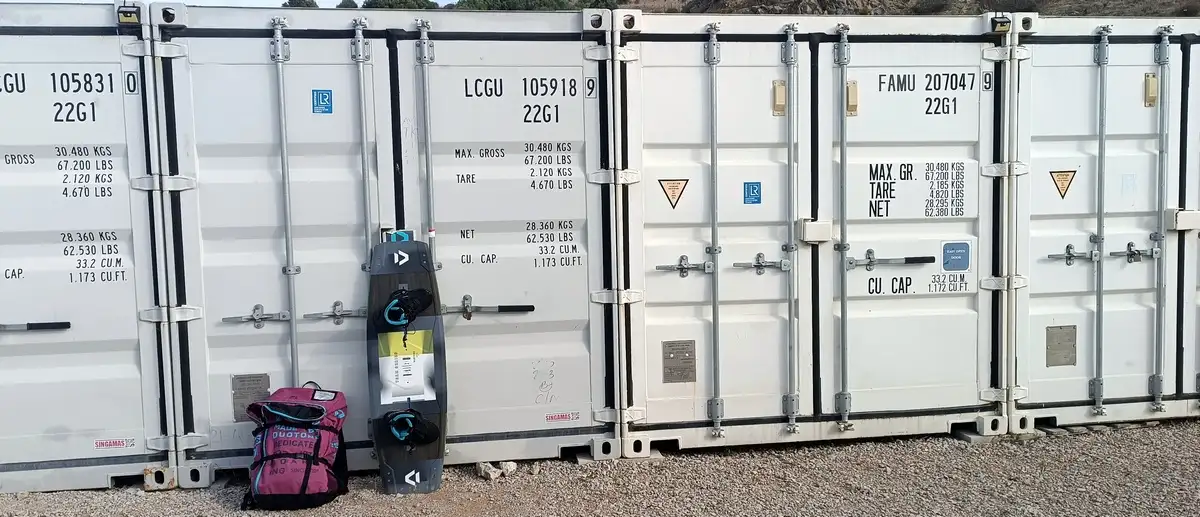
If you live in or spend time around the Bay of Cádiz (Valdelagrana, Cádiz or Sanlúcar), one option is to rent a storage unit in El Puerto de Santa María. They are 14 m² shipping containers, watertight and with ventilation grilles, at street level and with 24-hour access, surveillance and an individual padlock. They cost €150 + VAT per month, with no lock-in, and you can park right at the door to load and unload.
Let's be realistic: it is a big space. It makes sense if you have a lot of gear or practise several disciplines. Because of the distance, it is meant for people around the Bay of Cádiz, not for those who live in Tarifa!
Quick checklist before storing
• Rinse everything with fresh water.
• Dry it in the shade until no moisture is left.
• Check lines, bladders and stitching, and repair whatever needs it.
• Fold and roll without squeezing.
• Nothing heavy on top.
• Away from sun, heat and damp.
• Write down what is in each bag: when the season comes round again you will thank yourself.
Looking after your gear costs little and saves you buying new before you need to. When the wind comes back, may it find you ready.




Carla and Rodri, combined experience flying kites of more than 30 years. And a Kitesurf World Championship...🔥